Monday, July 29, 2013

Labour of Love

Recently the royal family garnered an extraordinary amount of attention concerning Princess Kate’s “labour.” I have no issues with pomp and circumstance, but I was shocked at how the media sensationalized every moment of this woman’s pain. It caused me to wonder about what labor meant to everyone else.

Commonly, labor describes the struggle to bring a living being into the world through excruciating pain. To others labor means simply the daily struggle to work enough hours to pay bills. Either way, it’s about struggle and goals. It got me to thinking “what do I labor to achieve?”

To many this question may be to simply survive, to others it is the pursuit of an ideal, and to still others it is the striving toward transcendence. Such is my direction.
If anyone ever asks me “How is that you can kill something that you claim to love? You mustn’t love it very much.”

If love can be measured by the depth and breadth of one’s effort, I submit to you the following: 

Shortly after the hunting season closes, I am subject to withdrawal – not unlike losing a love.

I immerse myself in pity, surrounding myself with the accoutrements of my passion. I tenderly put away decoys, winterize the boat, fog the engine, and almost shed a tear when I have to put the tarp over the hull. I clean my duck and goose calls with tender loving care, waxing the tone channel below each reed and gently placing their lanyard each on their own coat hooks. The pockets of the heavy camouflage clothing are emptied of shells, cotter pins and assorted edible nuts.

When everything is in its place, the melancholy sets in, like an unwanted guest promising to sit with you while you heal from the loss.

After a month of grieving, hope returns. It starts with a memory.


As a young man I recall the intense anticipation prior to that most sacred of days, The Opening Day. I would sit up all night in the basement, cleaning my gun over and over again, wistfully inhaling the smell of Hoppe’s #9 solvent, the combination of warm wood and cold blued steel in my hands, transporting me to the fields and swamps of my imagination. I would the colorful leaves float earthward in the outdoor spotlight and every hour I’d listen to the weather report to check the wind direction and speed. I was 14 years old and already the bug had found its way into the center of my soul. I am a hunter. 

40 years later, I sit in my den surrounded by duck prints, a significant library of all books waterfowl, a mounted double banded drake mallard and a glorious grained wooden gun cabinet.

I begin practicing my duck and goose calling daily, listening to CDs in my truck. I begin collecting all the pictures and short videos of the season and start crafting a 6 minute video to show at the Yankee Sportsman’s Classic. I send in my Harvest Report to the US Fish & Wildlife and make a long list of new equipment I’d like for next season, perusing Cabelas and Mack’s Prairie Wings.  I visit North Country Sportsman’s Club in Williston on Sundays to keep my shooting sharp.

Soon, spring creeps in and thoughts of a new hunting dog start playing in my head at night. 
Spring training consists of teaching straight line retrieves, “back” commands, “over” to the right and left, always with the scent of duck wings on the training dummies. The boat gets unwrapped and the repairs begin. The crack in the transom needs attention as does the hope of adding a new drain plug. The grass rails on the foredeck need to be re-built, and after ripping off the plywood floor, I want to add drain holes in the ribs so water flows freely to the back of the boat toward the new drain plug. The blind needs new zippers where the dog jumped through the side panel instead of exiting through the door like we’d trained. The motor needs a tune-up, new plugs, fresh oil and lube in the lower gearcase.
Next thing I know, its summer. I order a new drybox for shells (last year’s cardboard boxes didn’t hold up – even in the custom shellbox/gun carrier mounted on the starboard side of the cockpit - thank you Tim Hawley!) A new spotlight and headlamp are procured and anchor lines are tied to sparkling new greenwing teal decoys. Trailer wheels must be lubed, grease fittings on the boat and motor must be pumped full of the life-giving fluid. Bow and stern lights need to be re-wired for a better connection, PFDs and fire extinguisher must be checked, registration stickers must be purchased and a new steel keel guard must be installed.

July rolls in as the garden is recovering from the daily deluge and the annual visit to Dead Creek Refuge in Addison is upon us. A group of waterfowl lovers gather at the headquarters to strategize about how to round up 120 molting Canada geese into a pen, so that the biologists can sex and band them. The children carefully carry the newly banded birds to a holding pen where they regain their composure and are set free to return to their nesting sites. The sight of so many geese makes our collective hearts sing with joy.

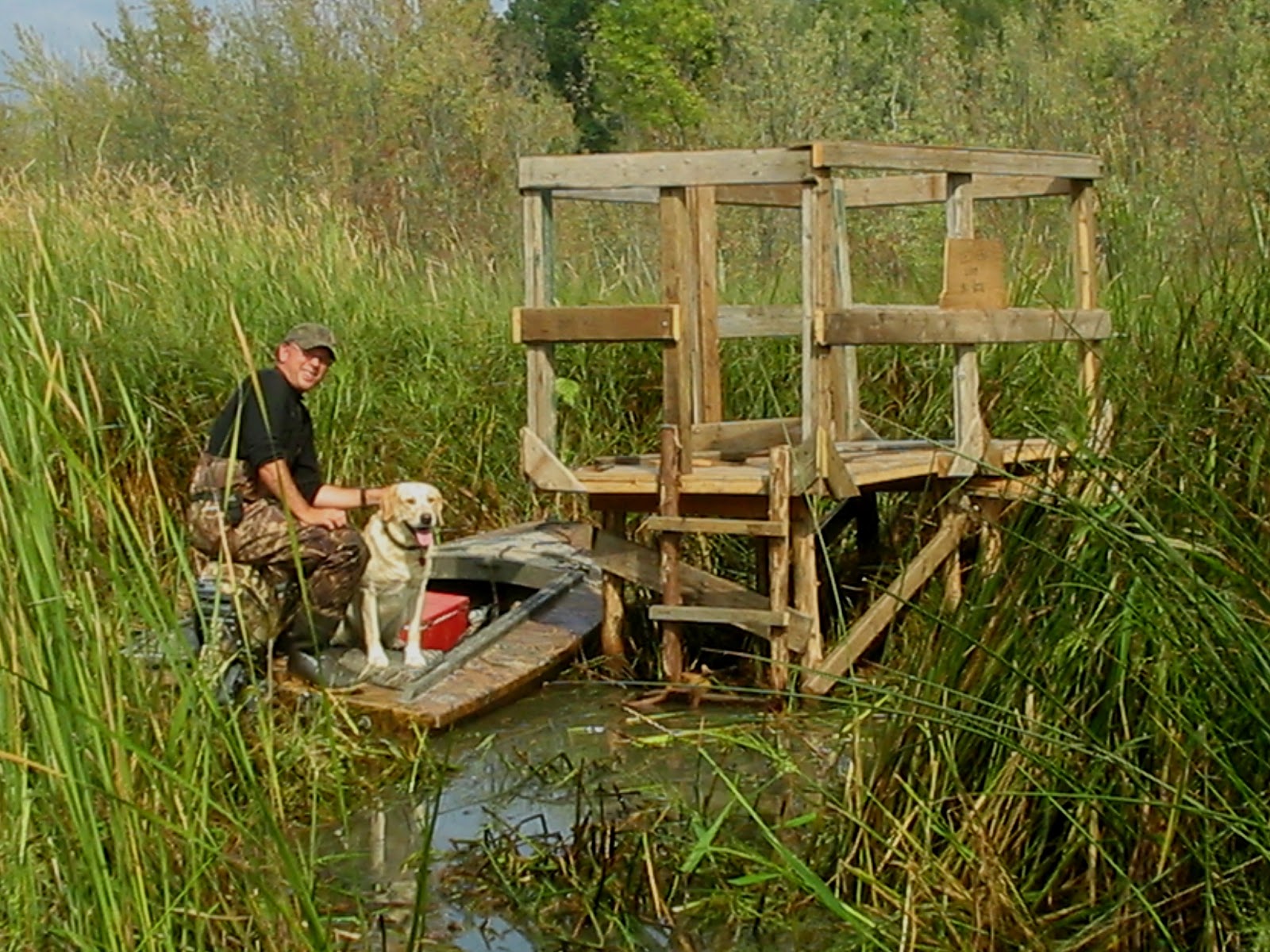
It’s now August and the pace increases. Work days on various farms are in order, blind platforms must be constructed of heavy duty plywood and 4x4’s, 6am scouting missions are now de rigeur on days when the temperature dips below 50 degrees the night before. Decoy lines need to be checked for wear, anchor knots need to be checked and re-tied, and calling sessions take on a new intensity. 5-stand sporting clays are now being executed twice weekly. The 12 gauge is being cleaned and oiled three times a week. Many hours are spent watching the 12 different weather channels on the computer and NOAA weather blares non-stop in the truck like an underscore to the goose calling repertoire. I set out all my goose decoys and wash them with mild soapy water, rinsing them with the hose and letting them dry in the seething August sun.

The pup needs to swim in the pond every evening, and as we arrive to train in the water, a doe slips out of the cattails and bounds up the hill to the small wooded pinnacle. A pair of mallards, just gaining their fall plumage, explodes into the blue sky and beeline for the next pond downstream, quacking their displeasure as their pinioned wings grasp for altitude. The dog whines in excitement. In the sunlight, an aluminum band shines on the drake’s leg. My heart skips a beat. Waterfowl season is now just 30 days away.

One of the layout blinds needs to be sewn. A 36” long tear must be hand-sewn with a needle and 10 pound fishing line, penetrating 600 denier cordura cloth. After 2 ½ hours my fingers are bleeding and I am asking myself “Why do I do this?” I answer myself out loud “Ducks!” Winter wheat colored raffia is ordered along with 300 plastic snap swivels and 600 cable ties. Every weekend this month we will be tying the camouflage twine into hanks that will be attached to the stubble straps on our layout blinds. 

In August, Ducks Unlimited hosts their annual Pig Roast and Fun Shoot in Waterbury which provides all of us a chance to shoot clays out of a boat and a layout blind and support our favorite charity.

Finally, the closing bell of summer rings. The Public Waterfowl Meeting is held on the second Wednesday of the month. About 60 of the most rabid waterfowlers show up to heatedly debate their preferences for whether the Opening Day should be on a Wednesday versus a Saturday and how long the split should be between the first and second half. Voices are raised passionately. Then a round of applause is given for someone exhibiting a modicum of common sense. The room is full of fanatical personalities that all want a season that gives them the best chance at making memories that will last the rest of their lives.

The day after the meeting the race to Opening Day is on. Final paint touches are put on the
old decoys and spots in the swamp are claimed. On the first Saturday of September, at
precisely midnight, some duck hunters are pounding in the first stake of the season for the blind they intend to occupy. There has been many a midnight that I have built blinds by the light of my headlamp, standing in 2 feet of water and mud.  Banging 15’ cedar posts into the muddy bottom with an 8 lb sledgehammer until they’ve sunk deep into the primordial ooze - in the dark - epitomizes the craziness to which a waterfowler will go to stake his claim.

As I pound in the heavy stakes, surrounded by my friends who are equally as obsessed, I laugh and ask “What in the world drives us to do this?” In between the thud-thud-thud of the hammer we hear a sound like someone tearing silk. We all look up at once, into the starlit heavens, and someone says “Did you hear that?” Whistling wings are slicing the night air above us. “Ducks!” I say. “Ducks!”


In my thesaurus, labor is defined as “toil, sweat, struggle, and endeavor” and for what you say? What captures our souls and drives us to subject ourselves to such struggle? Why the love of the sound of whistling wings against the dawn, my friend. Love, I say.

Thursday, June 27, 2013

The Beginning of Traditions


About 9 years ago, a woman from the Shelburne Community School asked me if I would consider mentoring a young man who was challenged to adhere to some basic social tenets of the institution. I accepted the challenge and began meeting him once a week during school time. We got to know one another and realized that we shared a common passion, the outdoors.


We would talk at length about things that 14 year olds experience and soon formed a bond, where in the hour we would spend together, he taught me one of the most valuable lessons of my life; that my actions could have a significant impact on someone younger. What I said, what I thought about, how I handled my own life, even my deep passion for hunting and fishing, became the central driver of our connection.


Soon I was introduced to his caretakers and found that our relationship took on a new form; that of ice fishing partners. I would work him into my weekly rituals of jigging for panfish, sitting on a pickle bucket out in Shelburne Bay. Sometimes we caught yellow perch, sometimes the nearly translucent rainbow smelt, but every expedition we undertook, I learned more about my purpose in life. 
The Art of Patience
My strongest desire is to share the world of the hunter, fisher and gatherer with others who might not otherwise consider it. I mentored 7 more young men over the following 8 years and started writing about my outdoor exploits. Soon, I was offered a monthly column in a regional publication, then another. Before long, my passion was bringing me greater rewards than I could have imagined. I decided to start a mentoring program based on the belief that Nature can teach us so many valuable lessons, as well as comfort us in times of stress. I decided to call it “Traditions Outdoor Mentoring.”

Our mission would be to work with at-risk young men who may not have a male role model in their life and teach them outdoor pursuits focusing on respect, empathy and compassion. We took two young men at a time and constructed an outdoor curriculum that encompassed habitat management, species identification, firearms safety, hunter education, animal calling, camouflage, scouting, landowner relations, etc. For more of the lessons we offer, go to our website, Traditions Outdoor Mentoring.org  and click on “Curriculum.” 
Seeking Oneness
This program often found that young men with ADD or ADHD, anti-social behaviors or anger issues slowly dissolved through the application of time spent outdoors and being mindful of the earth and all its manifestations.


We had one young man, who recently contacted me after 5 years of finishing the program and asked me to be his Best Man in his wedding next summer. He had come to us as a student who had been “rescued” from joining a metropolitan gang in Texas. During a particularly difficult time, his psychiatrist had told us that he was a sociopath and would inevitably wind up in jail. His school counselors, therapist and I refuted his opinion and we continued to work with him. He is now a mature and responsible young man who works several jobs in Rhode Island and cares for his fiancé and 1 year old child.


Another young man came to us wrestling with self-confidence issues and was just trying to find his way through adolescence. He mastered waterfowl hunting, scouting fields for geese, learning decoy sets and became truly an expert at the sport. One day he announced to us that he wanted to serve his country and joined the Marines. He is now serving in Afghanistan. Although I do not like to embrace war as a solution, we are very proud of his desire to serve his country.
Learning Joy and Responsibility
Currently, we have a young man in our program that has gone from boastful and angry to a maturing 15 year old that is learning the peaceful art of flyfishing. His casting abilities astound me. What took me 15 years to master; he imitated and reached in less than a month.


While mentoring these young men I recognized that there was a small but growing community of people here in Charlotte, that wanted to be able to connect to their environment on a meaningful level and perhaps even consider that they might want to be responsible for the meat and vegetables that they eat. We began teaching foraging, basic hunting ethics and fishing to those who were curious about where their food came from.


From this idea evolved Sacred Hunter.org, which now incorporates Traditions Outdoor Mentoring and writes several articles a month, sponsors Free Fishing Day, and gives speaking engagements for several outdoor venues like Dead Creek Day in October or the Yankee Sportsman’s Classic in January.


We are currently conducting an online campaign to raise funds for more equipment for our young men. If you have ever felt compelled to contribute to a cause that believes we can all benefit from direct contact with Nature, please visit our website, Facebookpage and make a donation to our campaign at Indiegogo.com.


Thank you for your consideration. Now get outside!

Tuesday, June 18, 2013

One for Two on the Fourth


It’s a hot lazy day in July. The garden is in. The parade has passed and the tractors are still idling in the field preparing to start the second cut. In the distance a child squeals happily and the sound of popping fireworks shatters the late morning air. The chickens in the back yard run for cover with that silly gait that only chickens can perform.Our horses whinny and bolt into a trot for the lower paddock where the grass is still lush and full. My wife is lounging under the yellow striped umbrella on the terrace, reading the first of many summer books written by a friend of ours, Stephen Kiernan, titled “The Curiosity.” The lawn was mowed yesterday and the smell of fresh cut grass languishes in the warm air currents sweeping in from the Southwest. Suddenly I catch a whiff of the lake. Sometimes, when the wind is just right and the lake is turning over its cold sub-surface, I can smell the seaweed and fishy smell that I love so much. It inspires me.

I saunter into the house and call my friends, Chris and Rudy to see if they’re busy on this holiday afternoon. Chris affirms that he is just lounging around “like an old log” and Rudy is bored watching children’s’ shows that his young daughter adores. I ask them both “How about we head out to the Lake and drag a downrigger ball on the bottom out near “the Bowl” in Whalley Bay?” The question resonates with both of them “Anything is better than sitting around wasting a beautiful afternoon” Rudy replies. “OK. Let’s meet at Chris’ in an hour.”

I collect my favorite Norbert Buchmayr Society cooler and grab some smoked salmon spread and cucumbers I’ve made for this lazy holiday. At the corner store, I add a six pack of my favorite adult beverage, a bottle of cooling fruit flavored seltzer and two bags of ice, then pour the ice over the contents of the cooler. Impulsively, I grab some smoked salami and Cabot cheddar cheese and add that to the top of the ice.

I am grateful for air conditioning in my truck today as I glance at the temperature on my dashboard. 84 degrees. Did I remember the sun block? Check. It’s in the backpack. Pulling into Chris’ house I am not sure I want to get out of the truck and step into the sauna of mid-day heat emanating from the asphalt driveway. I tell myself that the breeze will keep us cool on the lake.

We launch from Converse Bay, where it is obvious that we are not the only sun baked holiday revelers seeking refuge on the cooling waters. Chris launches the Hawk 18’ with his Volvo and drives the boat off of the trailer. The fragrance of the lake embraces our senses again as we slowly pull away from the docks installed by the Charlotte Sportsman’s Alliance. As Chris pushes the throttle forward on the center console the big-chested boat throws water in an arc from the bow, where the spray catches the sunlight and twinkles like a thousand stars in the summer sky.

We head West across the broad lake in silence, wind blowing through our hair, lost in the transcendent bliss of a July summer day.

As we swing past Split Rock we throttle down and Rudy and Chris man the riggers. I grab the wheel. Soon we are at laker speed of 2.0mph and the rigger balls are down 90’ with lines following 20’ behind the leaden orbs. Gaudy chartreuse and watermelon spoons bump along the bottom and as we slowly troll over the concave depression deep under the surface, the starboard rod releases, springing up from its arc. “Fish On!” I yell. Rudy grabs the rod before Chris can even adjust his feet to turn toward it.

The rod bends downward to the surface. Rudy lifts it up to his shoulders and proclaims “It’s a Hogger! It feels like a throbbing telephone pole down there!” We laugh and watch Rudy deftly play the big fish. We know its good sized by the way the rod continues to bend toward the surface. The reel clicks out line as the drag slows down the monolith of the deep. He is on a slow run 90 feet below us. The battle rages on for 10 minutes before the fish begins to slowly tire.

Then, out of the clear blue, the port side rod pops toward the sky. “Fish On!” I yell again. This time Chris is on it like Mercury racing to the sun. He lifts the rod skyward and the Penn reel begins to scream against the pressure. “Let him run!” Rudy exclaims. “It’s doubles!” I proclaim. We all start laughing and giggling like children playing in the sandbox.

We cajole one another and the fight for both fish continues. Chris and Rudy have to change sides of the boat several times, lifting their rods over one another as one crosses behind the other. The laughter and teasing goes on for another five minutes until Rudy’s laker breaks the surface 20’ behind the stern. I grab the net with the rubber mesh and thrust it under the rolling laker. The rod on the net bends and the weight of the fish strains my wrists, extended well beyond my shoulders. We boat him and admire his girth.

Next we turn to Chris. We are trying to land another behemoth, which seems as large as the first. The net is extended again and the fish lands squarely in the mesh. Suddenly, he thrashes and the spoon flies out of the basket. The laker is still in the net, but it’s extended precariously over the stern, 4 feet out over the water, and bending. Chris yells “Don’t lose him!” and as quickly as Chris can command us, the fish lurches skyward and rolls off of the rim of the net. He plunges into the depths and is gone in a heartbeat. Several expletives are employed with considerable exclamation and gesticulations.

“How can I have done this?” I ask myself. I apologize profusely and repeatedly. It was just too heavy to hold up when the net was extended that far out over the boat. A mistake I will remember for the rest of my life.

Silence falls and after several minutes forgiveness is acquired. I know that I have broken one of the rules of all accomplished fishermen – Do not extend the net beyond the stern so far that the weight of the fish is magnified. Wait for him to get closer to the boat before slipping the net under him. I tell myself I will never do that again.

Several more minutes pass and then Chris says “Alright boys! Bring up the riggers and turn the boat around. We’re going back for another pass!” That’s what friends do. Forgive and Persist.

The rest of the day is a blur. We boat several more lakers, all of them beautiful, but not quite the size of the first two.

As the sun begins to slide behind the Adirondacks, the breeze drops the temperature about 10 degrees in less than 30 seconds. The water has a gentle chop now. Our arms are red, even through the sun block. Our faces are weathered and dry. We are exhausted and hungry. It’s been an adventurous afternoon. 
 Chris turns the boat east and heads to the home port. Although the cooler is full of beautiful specimens, one stands out above the others. Rudy says “Not a bad day! We went 6 for 7.” But for me it will be remembered as One for Two. As I grin, my face feels a little cracked from the July sun and wind.

Skimming across the lake, the familiar aroma of seaweed and fish returns to grace my senses. And in that moment I am able to forgive myself and laugh at our good fortune.

The sun sets over the New York skyline and another holiday is punctuated by the distant percussion of children’s firecrackers.


Monday, May 20, 2013

The Evolution of Consciousness - or How I Learned to Stalk the Wild Asparagus

When I was a young man in high school in Beaver, PA, which in the 1960’s was the heart of the burgeoning steel industry, my mother used to hang our bed sheets out to dry on a line and I would marvel at the small rust colored rings that formed on the crisp white linens. It looked like tie-died “hippy” clothing. In the center of the ring was a tiny iron particle that had attached to the sheet by floating through the heavy air. Its origin was the steel mills spewing particulates and smoke into the air. We all took it for granted that this was “progress” and we should be grateful for the chance to live in such a prosperous country. It never occurred to me what we were doing to the environment. The “environmental movement” was just beginning.

They called it “ecology” and a very small group of eccentric individuals embraced this counter-culture, wearing peace signs and claiming they wanted to “get back to the land.” One of them wrote a book called “Stalking the Wild Asparagus.” 

In our high school, everyone was focused on Friday night’s football game and who had the fastest muscle car. This alternative group of rebels were joining what they called a “movement” that a lot of people feared would topple the status quo. My friends and I sat in the school hallways and made fun of “them”. We joked that Euell Gibbons, the author of “Stalking the Wild Asparagus” was actually a direct descendent of a simian culture and that the concept of “natural food” was foolish. Isn’t all food “natural?” Why eat vegetables that grow in a ditch when you can buy clean, unusually large and well-polished varieties in the supermarket?

Fast forward to the present. The “Environmental Movement” has evolved and been inculcated into the common fabric of our society. Everyone is at least aware of the impacts of pollution, ecosystem degradation, etc. We talk of habitat and clean water. We are aware of our problems, although there are still detractors who feel that the environment vs. the economy debate cannot be resolved. It’s one or the other. Personally, I believe that without a healthy environment, we cannot possibly sustain a healthy economy over time.

Our food is now produced by corporations that splice DNA together to create prettier, larger tomatoes, corn, soybeans, etc. and now we are headed toward the first genetically modified meat, farm-raised salmon that will not even need to be designated as a Genetically Modified Organism (GMO). Remember the sci-fi film back in the 70’s, “Soylent Green”, where the government produced a “super-food” that could replace all the other sources of nutrition? Are we headed toward a government sanctioned corporate-produced food supply?

Because of what I have learned over the years as a hunter and fishermen, I became fascinated with the concept that “pure” food could be healthier than processed food. After all, why did the venison, duck, goose, rabbit, squirrel, moose and bear taste so much better than anything I could buy in a store? I hypothesized that it had to do with the quality of life of the organism. My animals were free to roam the earth, seeking their sustenance from natural sources. Their life, although hard at times, was free and beautiful.
I postulated that perhaps that beauty, that freedom, that universal quality of spirit, was ingrained in their DNA and thus, in their flesh. By ingesting their flesh, with a blessing of gratitude, was I not then also absorbing their spirit?

Taken one step further, if I learned to locate plants that grew naturally in the woods, swamps, steams and ditches, would they not also have spiritual qualities like that of my animals?

I became more curious about this way of thinking and began to study the environments that might support such life. I asked some old-timers who seemed to know how to live well in spite of having few material possessions. It was these elders that taught me about fiddleheads, leeks (also known as “ramps”), dandelion greens, mushrooms, berries and nuts. Then one day, I met a man who showed me pictures of several pounds of my favorite vegetable, asparagus. Randy Bibeau, of Vergennes VT, has mastered the art of locating these wild edibles and he shared his knowledge with me.

I became obsessed with locating the dying stalks, gone to seed in the mid-summer heat, and drove hundreds of miles of back roads with my Northern Cartographic map by my side. Every time I spotted a plant I would mark it on the map with a circle with an “A” in the middle. I collected 20 spots in my first year. Randy had taught me that it is imperative that I search for these plots, although the actual stalks had passed and gone to seed, because the following year, those seeds would sprout quickly when the ground temperature reached the mid-60’s. During hot weather – like what we experienced here in VT during the first week of May, the plant can grow as much as 6” per day. During periods of unusual warmth, I learned to check on my plots daily, many of them yielding 3-6 newly sprouted stalks each day.

Recently I took my wife, Katie and her friend, Kelli Wellings of Addison, on an asparagus stalking drive. We drove down an old dirt road near a farm, where an old fence had once stood and now the barbed wire and aged posts hung drearily close to the ground. I was telling them about how the plant likes a saline habitat and thus, any time roads salt is used in winter, it thrives, when suddenly, I told Katie excitedly, “Slam on the brakes! There it is! There it is!” Katie and Kelli broke out laughing at my enthusiasm. Katie said something along the lines of “My God! You’d think he’d found a pot of gold! I haven’t seen you that excited in a long time!”
I literally jumped out of the truck and called back to Kelli, “Hurry up! C’Mere! C’Mere!” I sprinted across the desolate road and parachuted into the ditch. “Whoo Hooo!” We’ve struck the jackpot!” We picked a dozen spears and then, with a feeling of great accomplishment, crawled back in the truck. Further down the road we hit another patch, even larger than the first. Nice big, thick-stalked spears near an old mailbox of a deserted trailer. I was elated. The girls were fascinated by my unbridled joy at finding such a treasure. And the season had just begun. Asparagus “season” runs well into June in the Champlain Valley. 

On the ride home, I thought of my friend, Michael Hurley from Beaver, and how we used to make fun of old Euell, when all of a sudden I realized – Oh My God! I have become that person whom I used to satirize. Was I regressing physiologically to a simian or was I evolving into someone that found his spirit nurtured by a nature I had not understood?

That evening we dined on roasted asparagus and Lake Champlain poached salmon with sautéed wild leeks that I had harvested that morning. The sheets on the bed were clean and crisp with no iron deposits.

Saturday, May 4, 2013

Long Live The King!


I had been watching the old tom for a couple of weeks. I was taking notes in my journal as to what time he awakened each day, where he roosted, what fields he favored during rainy days and which hens commanded his attention from the fly-down to the time they sauntered off to nest in the late morning warmth. He had worn his wingtips down to the heavy-vaned quills from strutting in defiance and aggression, showing the young upstart jakes that there would be no mistake who sat on the throne and ruled this pastoral kingdom.

During the late morning he wandered across the brook where the little wooden bridge arched over the gently gurgling waters below. Dandelions covered the greening field like a bright yellow quilt. In the distance, the Adirondacks glistened in pale blue, almost blending into the cerulean sky with wisps of wedding white clouds hanging above them. With the girls attending to their domestic instincts and dusting their bronze bodies in the light brown bowls of earth, his Majesty would strut amongst the fiddleheads and ramps up and down the streambed.

Late in the afternoon he would meander through the main field and cross into the sprouting soybeans to gather his harem for the night’s feeding session at the edge of the small meadow. Gnats and small insects would hatch off of the twigs of the budding shrubbery, grubs could be scraped up in the cooling earth and the occasional left over acorn might yield its sweet tannin- flavored meat to the flock. They would stroll about, chatting amongst themselves, gently purring and clucking tones of contentment.

About 7:45 the flock would head into the hardwood and conifer woods, scraping the forest floor as they went and picking up the opportunistic earthworm along the way. At the base of the roosting area, they would putt-putt to one another, choosing their trees with a flapping of their decisive, powerful flapping wings. I could hear the wing beats from 100 yards away, as I sat on a fallen log covered with cool moss. Every once in awhile I would catch a glimpse of wings, lifting the big birds up into the dusky horizon to light on a thick branch.

As the heavens turned a dark green and purple, the old tom would start to gobble to let his mates know which tree he had chosen for the evening. I sat quietly, choosing not to employ my owl call and just listen to the birds call to one another using soft tree yelps, which would be punctuated every 5 minutes by a boisterous deep-throated gobble. Then the woods fell silent.

It was dark. The three quarter moon had just begun to crest the Green Mountains to the East. I stood up and quietly walked out of the woods, placing each footfall carefully so as not to snap any twigs. I stuck to the logging road that wended by the old sugar shack. The walk home seemed short, my heart doubling the pace of my steps. I could feel it beating in my chest with the anticipation of the next morning.

This particular year I had not been able to manipulate my schedule to accommodate Opening Day and had to settle for the first weekend. My concern was that any one of a number of other hunters may have already played this bird, but he seemed unflustered and relaxed. My hopes were high as I lay in bed watching the reflection of the LED light on the alarm clock glowing an oddly calming green on the ceiling. As I began to drift off to sleep, a flock of geese flew over the house in the subdued moonlight, headed for the pond out back.

The fluorescent light of the clock read 3:58 when I opened my eyes. The alarm would go off in 2 minutes. No need to wake the wife with the local country radio station wailing the teen angst of some young girl who is “never ever ever getting back together” with some spurned adolescent boy. Maybe if it was Waylon Jennings or Johnny Cash, I might consider lying in bed and actually listening to some classic old tune, but I know better these days. The radio stations no longer play the kind of music that soothes old souls. So I turned it off before the inevitable.

I rolled off of the firm mattress and directly into my turkey camo laid out neatly at the foot of my bed on the red couch under the window. The curtain was being vacuumed out through the top of the window by a South wind circling around the house. It would be a warm day. I could feel it in my bones.

Walking down the dirt road, my boots were scuffing the gravel when I realized that it was dead silent and that I was not conscious of creating more noise than I liked. I began setting my feet down with more mindfulness. My plan was to walk the road to the culvert and short-cut through the woods to a slight rise where the birds funneled through the low point to the fence with the broken posts where the barbed wire was torn, creating an opening to the soybean field.

As I crossed through the fence opening and into the woods, I had that sixth sense that I was being watched. I felt my nerves go on edge. Was it a coyote? A roosted hen that had changed its course into another tree during the night? Something felt uneasy. I tip-toed through the moonlit trilliums and carefully placed each step, feeling for branches or twigs through my rubber soles. I stopped to listen for a moment next to an old oak.

My heart jumped into my ears when the owl went off right above me. “Who cooks for you? Who cooks for you? Who cooks for you awwwwl?” Then a thunderous gobble echoed through the night air. My heart moved back into my chest and decided to try to push its way out though my ribcage. I broke into a cold sweat and began gasping shallow breaths. “Calm down” I told myself. “Now you know where he is and all you have to do is wait.”
 
I leaned my vest and gun against the old oak and gently removed the hen and jake decoy from the backpack. I unfolded them and carried the decoys and their plastic stakes,carefully pacing off 20 yards to my left, toward the swale in the ditch. I strategized that he might not cross the ditch but would pass on the opposite side following his normal routine exit to the field. It would leave me with a shot of about 30-35 yards, for which I had patterned my 12 gauge using some 3 ½” #5 ‘s Then I returned to my tree and saddled up against the indentation in the trunk.

I cut a few small twigs with budding leaves out of the musty soil and speared them into the ground in front of me, creating a ring of natural cover. My 3-D leafy-flage suit blended in beautifully. I had loaded my gun back at the house and walked all the way in being ever conscious of the safety as I wound my way through the whip-infested woods edge.

I sat at the base of the old tree and listened to the prelude to a spring symphony. 

 Every 5 minutes or so, the percussive deep-throated bass of the lead singer would pierce the crisp morning air, ripe with hope.

Soon, I began to hear fly-down cackles and the beat of mighty wings in their descent to the earth below. I counted 6 fly-downs that I could hear. Then an even louder beating of wings and a solitary gobble from 100 yards away. Then silence. His Majesty was being attended to by his harem of hens. The Boss hen clucked loudly to him to follow her directly to the small green meadow.

I clucked and putted gently at first, and then realizing that I was competing with a half-dozen of the real birds, I picked up the tempo and veracity of my clucks. He answered, affirming his dominance with a powerful scream.

At this point I knew I had his attention, but the game was far from over. Was it just a courtesy gobble? Or did I sound more seductive than the real-life ladies around him? I clucked loudly again, with a powerful cut at the tail end of the monologue. Again, he answered. I had confirmed that he knew of my whereabouts and my intentions. Now, the real tricky part of the conversation; saying nothing. At all. For what could be a long time. He had stopped gobbling for about 15 minutes and my heart began to sink.

Had he left his strutting zone to follow his Boss Hen into the meadow? I began to think about my next strategy when a voice from my past, the ghosts of Chris and Curt McCuin, whispered in my head “When they stop talking, they may be coming in. Sit tight and wait.” So wait I did.

Constantly scanning the holes between the trees, the shrubbery and the deadfalls, I began to feel as if I was being watched.  Again.

Suddenly a piercing gobble came from right in front of me, not more than 60 yards away.

Then I saw it. Just the top of the fan. It was full and he was strutting behind a downed cedar tree. He must have snuck in using the cedar to obscure my vision the whole way.

I putted gently. He gobbled back.

But he did not move closer.

I clucked and cut. He gobbled back.

But he did not move closer

I purred with a gentle cut. He gobbled back. We were having a conversation about who should go to whom.

He did not move from his strutting zone behind the cedar.

This went on for the better part of ½ hour, when finally I saw him angling away from behind the tree and heading back to his harem.

What should I do?

Dare I try that no-call mouth gobble that I have used to entertain people at parties? The one where I just scream “Owl doodoodooodoodle?”

It was then I realized I had nothing to lose.

I breathed in deeply and tensed the muscles around my diaphragm in my chest, using my intercostals to add pressure. Then I let loose, praying that the sound emanating from my mouth would sound anything like a jake challenging this brute to breed the hen I was pretending to be.

At the moment he heard the scream, he spun around like someone had punched him in the back of the head and screamed back.

Then he began to run, full speed. Around the cedar and right in to the decoys, which he had not seen from behind the tree. He looked at the jake decoy with incredulity and stuck out his chest, reared back on his legs and prepared to terminate the young upstart. He held his head high and prepared to pounce.

It was then that my finger eased the trigger back and the deep barreled gun spoke. Eloquently, powerfully and permanently.

I rushed to his side and sat with him as he expired, praying as I always do.

“Great Spirit, hear me for I am small and weak. I need your strength and wisdom. Let me walk in beauty and make my eyes behold the red and purple sunset. Make my hands respect the things that you have made. Make my ears sharp to hear your voice. Make me wise so that I may understand the things you have taught my people. Let me learn the lessons in every leaf and rock. I seek strength, not be greater than my brother, but to fight my greatest enemy, myself. Make me always ready to come to you, with clean hands and straight eyes, so when life fades as the fading sunset, my spirit may come to you without shame. Take this, my brother, back into the Great Star Nation and know that I am grateful for his sacrifice. Great Spirit bless this, the soul of my brother, the turkey.”


In the distance my prayer was answered by another gobble from out in the meadow. There will be a new King this day. Long Live the King!